
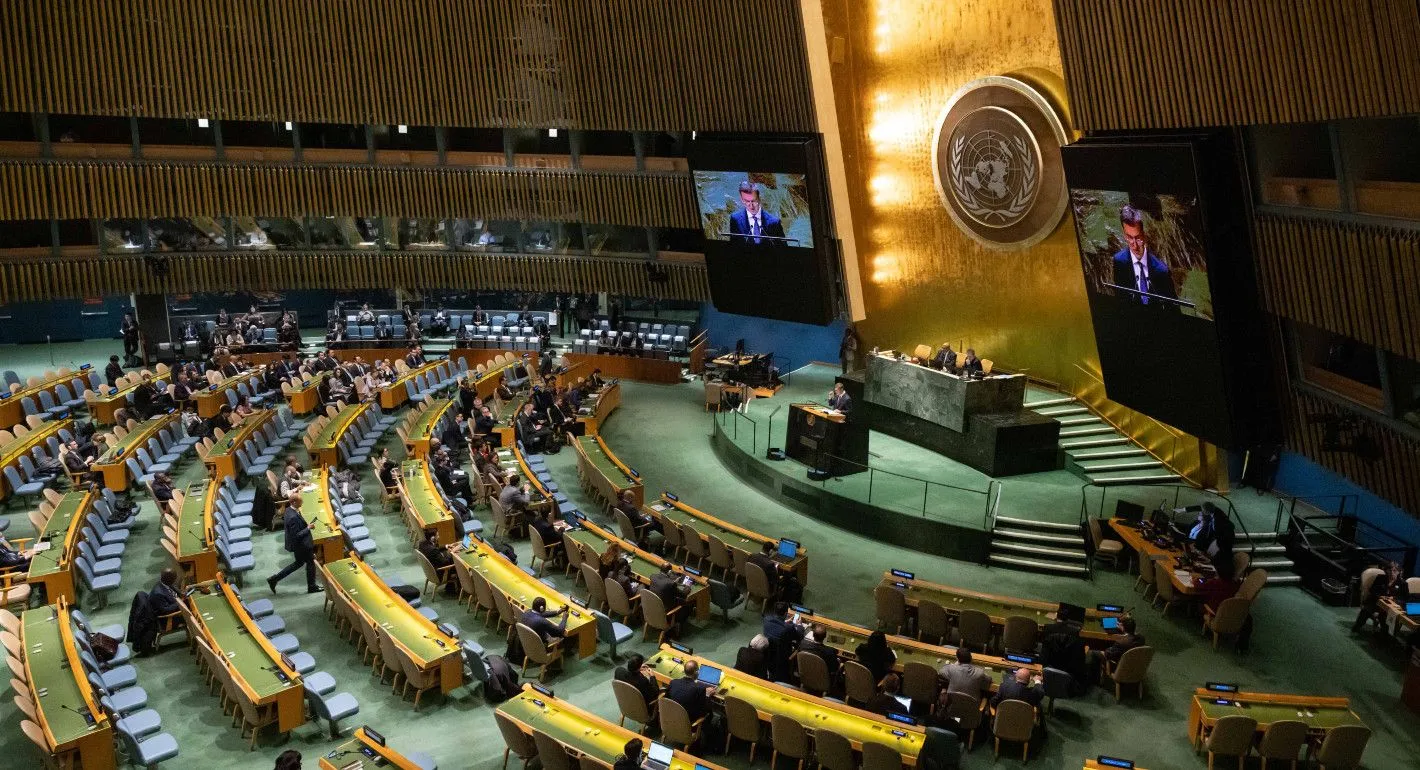
On March 25th, on the very same day Iranian missiles were falling on Kuwait International Airport, the UN General Assembly convened and voted 123 to 3 to adopt a resolution condemning the transatlantic slave trade as “the gravest crime against humanity,” calling for engagement in a reparative justice process that would include formal apologies, the return of cultural property, and financial compensation. Only three countries voted against: the United States, Israel, and Argentina. The entire European Union — all 27 members — abstained, along with Britain, Australia, Japan, and Oman.
The American legal arguments were clearly laid out in Deputy Ambassador Dan Negrea’s statement: Washington does not recognize a legal right to reparations for historical wrongs that were not criminalized under international law at the time they occurred, and it objected to any text that ranks crimes against humanity in a hierarchical order. These are legally coherent arguments with academic standing, but they ignore the broader political context of this vote at this particular moment.
What Washington did not say is that this vote is not read in African capitals as a legal decision — it is read as a sweeping political signal. At a time when the United States is asking African nations to support its position on Iran, to join a coalition to reopen the Strait of Hormuz, and to refrain from deepening ties with China and Russia, the response came in three letters: “No.” A “no” from 123 countries, set against Washington’s position and its cold, technical statement.
The immediate regional consequences demand attention. Ghanaian President John Dramani Mahama, the resolution’s chief architect and the African Union’s champion on reparations, emerged after the vote declaring that they had “stood on the right side of history.” This framing moves beyond legal language into the language of identity and civilizational stance — and that is politically the most dangerous register, because it shapes collective consciousness rather than merely diplomatic posture. Against this backdrop, the vote confirmed once again that China and Russia, both of which voted with the majority of 123, continue to craft their image in Africa as “friends of the Global South” — against a Western image that, to the African observer, appears biased and self-serving.
The long-term effect penetrates practical policy. The U.S.-Africa partnership summits that were held with great fanfare under Biden, yielding billions in pledged investments, will return to the table in an African political climate that is more reserved toward Washington and more inclined to use the China card as a negotiating lever. This does not mean African capitals will flip against Washington all at once, but it means the price of American-African cooperation on security and economic files has risen several degrees.