
The War Enters Its Fourth Year
Sudan’s war between the Armed Forces and the Rapid Support Forces entered its fourth year on April 15, amid a clear military stalemate. The army controls the northern, central, and eastern states as well as the capital, while fighting continues in Kordofan and the humanitarian situation in Darfur deteriorates further.
The Berlin Conference — Pledges Without Delivery
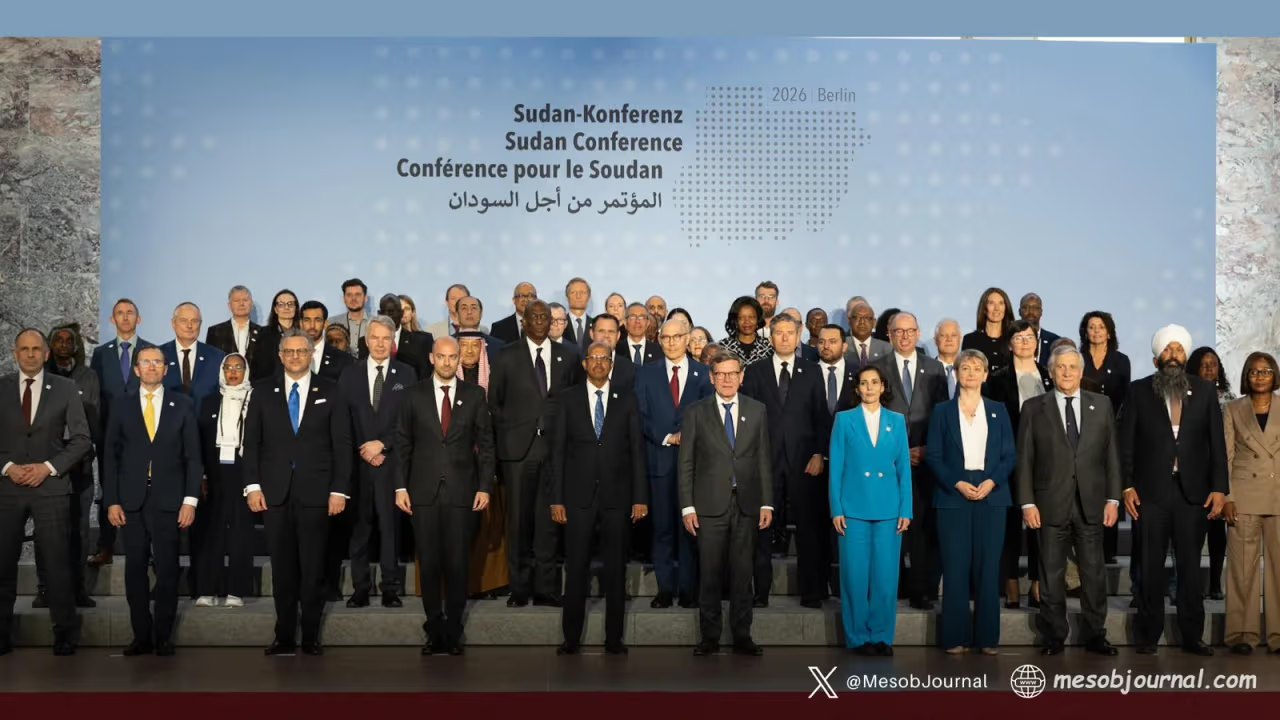
The Third International Conference on Sudan, held in Berlin on April 15, brought together ministers and representatives from 55 states alongside UN agencies, regional organizations, and Sudanese civil society. The result: pledges of €1.3 billion in humanitarian aid. Yet the gap between commitment and reality is stark — UN officials confirmed that actual funding secured had not exceeded 16% of requirements as of mid-April, while the total humanitarian ask stands at $2.2 billion to reach 14 million people this year alone.
The conference introduced a new “civilian track” alongside its humanitarian and political dimensions, providing a platform for Sudanese civil society voices to call for de-escalation and a path toward civilian transition. UN humanitarian chief Tom Fletcher set the tone from the podium, describing Sudan as “an atrocities laboratory” — citing the siege of cities, the use of rape as a weapon of war, and the systematic targeting of hospitals and schools. “Drones have killed 700 people just this year, and 130 humanitarians have been killed over three years,” he said.
The Sudanese government, however, was neither invited nor consulted. Khartoum issued a sharp condemnation, calling the conference a continuation of “colonial guardianship” that equates the national army with what it termed a terrorist militia, and warned that such an approach rewards armed groups and their political wings while undermining state sovereignty. Twenty-five political and civic groups aligned with the armed forces also boycotted the proceedings, citing exclusionary invitations.
What Comes Next: The Quintet’s Play
IGAD Special Envoy Lawrence Korbandy announced that the Quintet — comprising the African Union, IGAD, the UN, the EU, and the Arab League — will convene a follow-up meeting next month that includes all Sudanese forces absent from Berlin. He stressed that no agenda will be imposed, and that participants and topics will be decided by Sudanese actors themselves.
U.S. Sanctions — A New Pressure Card
On April 17, the United States imposed sanctions on five companies and individuals involved in recruiting former Colombian military personnel to fight for the Rapid Support Forces — a network the Treasury Department described as “fuel for the conflict.” Washington simultaneously called on both warring parties to accept an unconditional three-month humanitarian truce, with Treasury Secretary Scott Bessent stating bluntly that neither side has shown any commitment to protecting civilians.
The Humanitarian Catastrophe — Staggering Numbers
Sudan is now the world’s largest humanitarian and displacement crisis. Nearly 34 million people — 65% of the population — are in urgent need of support. Fourteen million have been uprooted from their homes. An estimated 70% of Sudanese now live in poverty, nearly double the pre-war figure. With the main agricultural season approaching in April and May, and half of Sudan’s fertilizer supply coming from the Gulf, the specter of a wider famine is growing more concrete by the day.
▌Why This Matters to America
This war is no longer merely a regional humanitarian crisis — it has become a direct threat to U.S. interests. A prolonged conflict expands the operating space for terrorist groups across the Sahel and the Horn of Africa. The sanctions targeting Colombian recruiters reveal that international mercenary networks are now actively embedded in the conflict, adding a new layer of complexity to Washington’s strategic calculus. Meanwhile, Berlin’s outcome — pledges without enforcement mechanisms — raises a harder question: can international conferences generate leverage, or do they simply document failure?
▌Possible Scenarios
Scenario One — Prolonged Stalemate: Washington’s proposed truce fails to gain traction, conditions continue to deteriorate through the agricultural season, and famine expands beyond current projections.
Scenario Two — Regional Escalation: Weapons flowing through neighboring countries and foreign mercenaries fuel the conflict’s spread toward Chad and South Sudan, locking the region into a proxy war with no exit in sight.
Scenario Three — Limited Thaw: Quintet follow-up meetings succeed in uniting Sudanese civilian forces and produce a partial humanitarian truce on select fronts, enabling some aid delivery without a broader political resolution.