
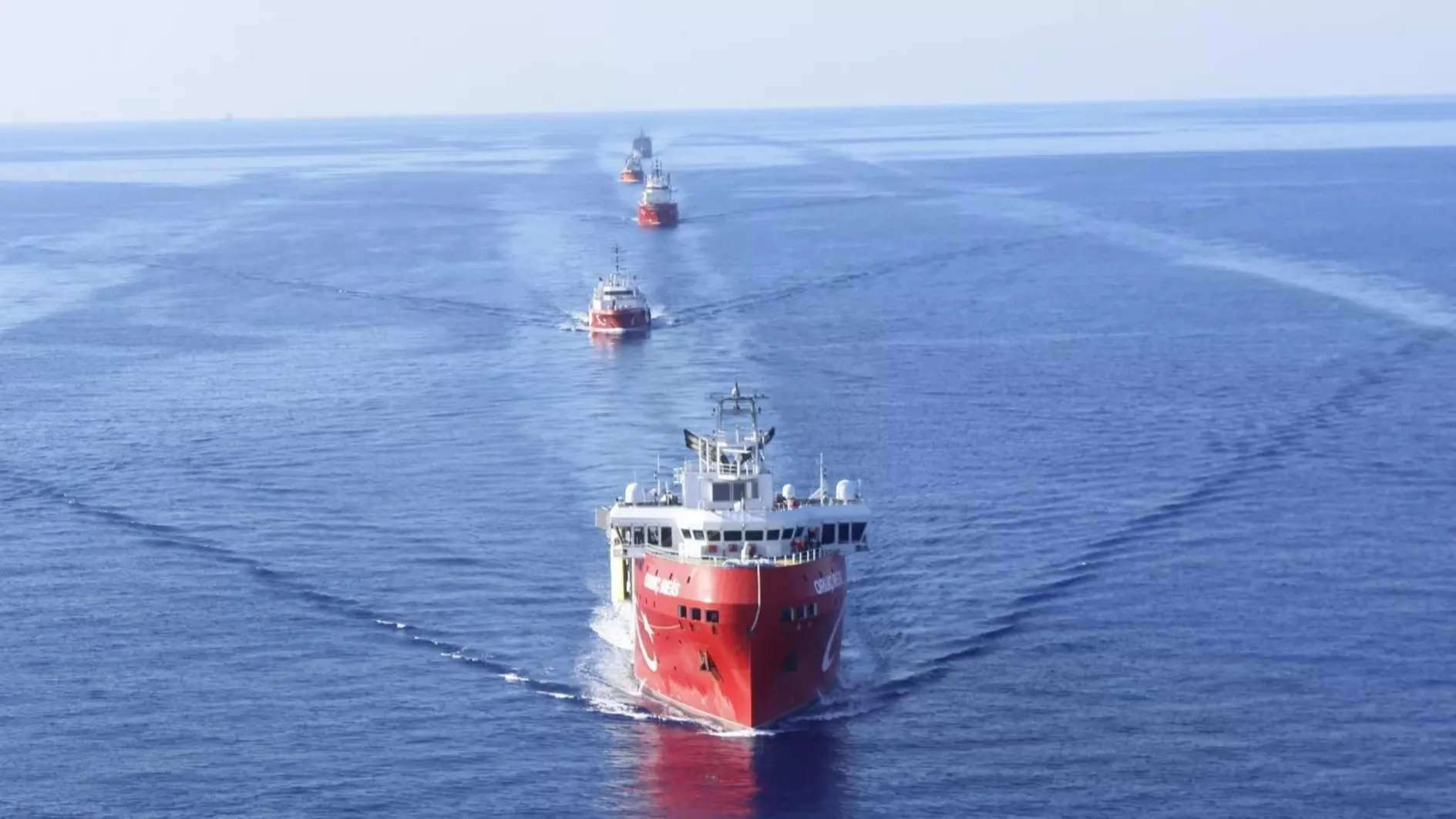
Turkey’s deep-sea drillship Çağrı Bey arrived in Somali waters today, Thursday April 9, 2026, completing a 53-day voyage from the port of Taşucu in southern Turkey — the first time a Turkish drillship has ever operated outside Turkish territorial waters. Energy and Natural Resources Minister Alparslan Bayraktar, who flew to Mogadishu for the arrival ceremony alongside senior Somali officials, declared that Turkey and Somalia were “opening a brand-new chapter in energy history.” The vessel will now proceed to drill the well named “Curad-1” — Curad meaning firstborn child in Somali — targeting a depth of 7,500 meters over an operation expected to last 288 days.
The vessel and the operation
The drilling site sits in Somalia’s “Central High” offshore zone within Block 153, roughly 370 kilometers east of Mogadishu, in waters approximately 3,500 meters deep — making it one of the deepest offshore drilling locations in the world. The target was selected after the Turkish seismic research vessel Oruç Reis spent 234 days surveying 4,465 square kilometers across three Somali offshore blocks. About 500 personnel will work the operation in rotation. Three Turkish Navy frigates — TCG Sancaktar, TCG Gökova, and TCG Bafra — are escorting and protecting Çağrı Bey throughout the campaign. Unable to transit the Suez Canal due to the height of its drilling tower, the ship sailed via Gibraltar, down the Atlantic coast of Africa, around the Cape of Good Hope, and through the Indian Ocean — a route made necessary by the closure of the Suez corridor amid the ongoing regional war.
The reserves: promising figures, unproven ground
Estimates from the Somali government, the US Department of Commerce, and survey firms suggest Somalia’s offshore basins may hold between 30 and 40 billion barrels of oil and gas equivalent. But these figures rest on seismic modeling, not confirmed reserves — not a single offshore exploratory well has ever been drilled in Somali waters to allow a commercial assessment. According to Rystad Energy, only 38% of exploration wells worldwide result in commercially viable discoveries. Curad-1 is therefore not a discovery — it is the first real test of whether Somalia’s anticipated wealth exists at all.
Beyond the oil: a layered Turkish presence
The arrival of Çağrı Bey is not an isolated event. It is the latest layer of a strategic footprint Turkey has been building in Somalia since 2011, when humanitarian aid after a devastating famine opened the door to long-term investment. Turkey went on to manage Mogadishu’s port and airport, then established Camp TURKSOM in 2017 — its largest overseas military base — and has since trained over 15,000 Somali soldiers, including naval and special operations forces.
In December 2025, Somalia’s fisheries ministry and OYAK — Turkey’s military pension and investment fund — signed an agreement establishing a joint company, SomTurk, granting Turkey exclusive licensing and enforcement rights across Somalia’s entire Exclusive Economic Zone in exchange for 30 percent of revenues. A February 2026 maritime security agreement added a ten-year joint naval force mandate and formally placed Turkish energy ships, including Çağrı Bey, under military protection. And in a detail that extends Turkey’s ambitions further still, Ankara is building a spaceport and long-range ballistic missile testing facility along Somalia’s Indian Ocean coast near Kismaayo, with phase one under construction since January 2026.
The “Blue Homeland” doctrine reaches the Horn
Turkey’s Blue Homeland strategy — conceived to extend Ankara’s maritime reach from the Eastern Mediterranean into the Red Sea and Indian Ocean — finds its clearest expression yet in Somalia. The Curad-1 drilling site sits roughly midway between the Somali coast and the Bab el-Mandeb strait, the chokepoint connecting the Red Sea to the Indian Ocean through which a significant share of global energy trade passes. One Turkish maritime law expert put it plainly: “If Somalia grants TPAO a license for oil drilling in its EEZ, that area becomes part of our Blue Homeland.” With Houthi disruptions to the north and sporadic piracy to the south, Somalia’s coastline offers Turkey a forward operating position without the formal appearance of a foreign base.
WHY IT MATTERS TO AMERICA
What Turkey is assembling in Somalia goes well beyond a drilling contract. Ankara is building military infrastructure, naval dominance over a 3,300-kilometer coastline, a missile testing site, and now energy rights — all clustered around the Bab el-Mandeb, a waterway Washington has been protecting since the Iran war began. Turkey moved decisively toward Somalia at precisely the moment the Strait of Hormuz was closed, framing the operation explicitly as a step toward energy independence from disrupted supply chains. The unanswered question for Washington: how does it manage a NATO ally that is quietly constructing a permanent strategic foothold in a region America considers critical to maritime security — without a base agreement, a congressional debate, or a bilateral framework to govern it?
THREE SCENARIOS
- Curad-1 confirms commercially viable reserves. Somalia becomes an emerging East African energy producer, government revenues rise, federal institutions are strengthened, and al-Shabaab’s economic base narrows — while Turkey cements itself as the dominant external power in the Horn.
- The drilling succeeds but triggers a competition for access. Washington, Beijing, Riyadh, and others move to offset Turkish dominance, turning Somalia into a new arena of great-power rivalry over energy routes and naval positioning near Bab el-Mandeb.
- The well fails to yield commercially viable hydrocarbons — a realistic outcome given industry-wide exploration success rates. The oil remains a deferred promise, but Turkey’s military, maritime, and institutional presence in Somalia is already entrenched and continues to expand regardless of what Curad-1 finds.