
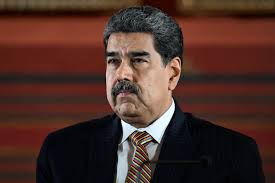
In an unprecedented legal and diplomatic precedent, the trial of Venezuelan President Nicolás Maduro in absentia begins today, Monday, January 5, 2026, in a federal court in Miami, Florida, on charges of drug trafficking, money laundering, and corruption. This is the first time in modern history that an American court has tried a sitting president of a sovereign state, a move that has sparked a massive wave of legal and political controversy globally.
Background to the Case: The first charges against Maduro were filed in March 2020, when the U.S. Department of Justice issued an indictment accusing him of leading a “transnational criminal organization” aimed at “flooding the United States with cocaine” in cooperation with former Colombian rebels from the Revolutionary Armed Forces of Colombia (FARC). Washington offered a reward of $15 million for information leading to his arrest.
The charges include:
- Drug trafficking: Coordinating the shipment of more than 250 tons of cocaine annually to the United States since 1999
- Money laundering: Using the international banking system to launder drug proceeds estimated at billions of dollars
- Corruption: Exploiting political influence to protect smuggling networks and facilitate their operations
- Conspiracy against the United States: Using drug trafficking as a “weapon” to destabilize American stability
The U.S. prosecution accuses Maduro and his prominent aides, including Diosdado Cabello (former Vice President) and Tareck El Aissami (former Minister of Industry of Lebanese origin), of turning Venezuela into a “narco-state” run by a corrupt military and political elite.
Recent Developments: In November 2025, the federal court in Miami rejected an appeal filed by Maduro’s lawyers demanding dismissal of the case based on “sovereign immunity” enjoyed by heads of state. American Judge Joan Lenard said in the ruling’s reasoning that “sovereign immunity does not extend to cover organized criminal activities targeting harm to the American people,” noting that “drug trafficking is not among the legitimate sovereign acts of any state.”
This decision opened the door to the trial in absentia that begins today, at a time when Maduro continues to rule Venezuela after the controversial July 2024 elections, which the United States and numerous Western countries refused to recognize, considering them rigged in favor of Maduro at the expense of his rival Edmundo González Urrutia, who sought asylum in Spain.
The U.S. Government Challenges International Law: Washington bases its prosecution of Maduro on the principle of “universal jurisdiction” against serious crimes, and on the “long-arm jurisdiction” law that allows American courts to try foreigners if their crimes have a “significant impact” on the United States, even if committed outside its territory.
However, international law experts are sharply divided over the legitimacy of this procedure:
Supporters say that the crimes attributed to Maduro – if proven – are serious enough to transcend sovereign immunity, and that his prosecution is necessary to protect American national security and combat transnational organized crime.
Opponents believe that trying a sitting president in a foreign court violates fundamental principles of international law, especially:
- The principle of sovereignty: which grants states complete independence in their internal affairs
- Diplomatic immunity: which protects heads of state from foreign legal prosecution
- Sovereign equality: which makes states legally equal and no state is subject to another state’s judiciary
Venezuelan Reactions: President Maduro described the trial as an “imperialist farce” and a “blatant assault on Venezuela’s sovereignty,” confirming he will not appear before an “illegitimate court in a hostile state.” In a televised speech last night Sunday, Maduro said: “This is a desperate attempt by Washington to justify its interference in our internal affairs and control our oil. We will not kneel before the empire no matter the pressures.”
The Venezuelan government announced a series of immediate retaliatory measures:
- Expelling American diplomats: Maduro ordered the expulsion of all remaining American diplomats in Caracas (about 12 diplomats) within 72 hours
- Nationalizing American assets: Announced confiscation of remaining assets of American companies in Venezuela, especially in the oil sector
- Alliance with enemies: Maduro called for an “international alliance against American hegemony” with Russia, China, and Iran
- Military mobilization: Ordered large-scale military maneuvers to “defend national sovereignty”
The Venezuelan Congress (controlled by Maduro loyalists) issued a resolution condemning the trial and considering it “legally void and morally rejected,” calling on the United Nations and the Organization of American States to intervene to stop “American aggression.”
Regional Reactions – Latin America Divided:
States Supporting Washington:
- Colombia: President Gustavo Petro, despite his leftist position, expressed “balanced concern,” noting that “drug charges are serious and must be investigated,” but called for “respecting Venezuelan sovereignty”
- Ecuador: The government welcomed the trial, considering that “corruption and crime do not enjoy sovereign immunity”
- Peru and Chile: Expressed support for “combating organized crime” without taking an explicit position on the trial
Rejecting States:
- Cuba: Strongly condemned the “colonialist trial,” confirming its full solidarity with Venezuela
- Nicaragua: President Daniel Ortega described the trial as “American judicial terrorism”
- Bolivia: President Luis Arce called for “respecting Latin sovereignty” and rejecting “foreign interference”
- Mexico: President Claudia Sheinbaum took a cautious diplomatic stance, emphasizing “principles of non-interference and respect for sovereignty” without explicit condemnation of Washington
Brazil in an awkward position: President Lula da Silva, who attempted mediation between Maduro and the Venezuelan opposition in 2024, criticized the trial describing it as “unhelpful for resolving the Venezuelan crisis,” but refrained from condemning it categorically, in a delicate balance between his relationships with Washington and Caracas.
The Organization of American States (OAS) witnessed sharp division, failing to issue a unified statement. Secretary-General Luis Almagro (known for his anti-Maduro stance) welcomed the trial, while 11 member states refused to vote on any resolution supporting the American procedure.
International Reactions – Major Powers:
Russia – Absolute Support for Venezuela: The Russian Foreign Ministry issued a harsh statement describing the trial as “blatant use of the American judicial system as a tool for political pressure and imposing hegemony.” Kremlin spokesman Dmitry Peskov said: “This confirms what we always say: the United States does not respect international law except when it serves its interests.”
Moscow announced:
- Additional military support for Venezuela, including advanced air defense systems
- New investments in the Venezuelan oil sector worth $5 billion
- Joint military maneuvers in the Caribbean during February 2026
China – Diplomatic Caution with Implicit Support: Beijing took a more cautious position, with the Foreign Ministry spokesman confirming “the need to respect the national sovereignty of all states” without naming the United States or Venezuela. However, China, which has invested more than $60 billion in Venezuela over two decades, indicated it “will continue normal cooperation with Caracas.”
Analysts believe Beijing benefits from the crisis to deepen its influence in Latin America, Washington’s traditional “backyard,” without entering into direct confrontation with the American administration.
Iran – Ideological Solidarity: Tehran condemned “American judicial aggression,” reminding the world that Washington “uses the same methods against everyone who refuses to submit to it.” Iranian Foreign Minister Abbas Araghchi said: “Maduro’s trial is a trial for every state that refuses American hegemony.”
Iran announced its readiness to “strengthen strategic cooperation” with Venezuela, especially in oil and military technology.
European Union – Diplomatic Embarrassment: Brussels is in an awkward position: on one hand, the European Union shares Washington’s concern about “democratic deterioration” in Venezuela and considers Maduro “illegitimate” after the 2024 elections. But on the other hand, Europeans traditionally reject “transgression of sovereignty” and prefer diplomatic solutions.
The European Commission spokesman merely said that “the Union is monitoring developments” and that “legal issues must be resolved according to international law,” in a diplomatic formula that neither supports nor explicitly condemns.
Spain, which hosts Venezuelan opposition figure González Urrutia, is in a more delicate position. Prime Minister Pedro Sánchez called for a “democratic transition in Venezuela” but avoided commenting directly on the trial, fearing complications for Madrid’s relations with Caracas where a large Spanish community resides.
Case Implications for the International Order:
First – Erosion of the Principle of Sovereignty: The trial sets a dangerous precedent that may open the door to mutual judicial prosecutions between states. If the international community accepts Maduro’s trial, what prevents Russia or China from trying American officials on charges of “war crimes” in Iraq or Afghanistan? This question raises growing concern among international law experts.
Second – American Double Standards: Critics of Washington point out that the United States itself refuses to recognize the International Criminal Court and does not allow its citizens to be tried before it. In fact, Washington issued the “Hague Invasion Act” in 2002 that authorizes the use of military force to free any American being tried in the international court. How can a state that refuses to submit to international justice try the president of another state?
Third – Deepening Global Polarization: The case increases the intensity of polarization between the “Western” camp led by America and the “anti-hegemony” camp led by Russia and China. Venezuela, despite its relatively small size, has become a symbol of this broader struggle over international order rules and who has the right to impose them.
Fourth – Impact on Latin America: The region, which has historically suffered from American interventions, is witnessing a wide debate about sovereignty and independence. Even “moderate” or “pro-Washington” governments have become more cautious in openly supporting American policies, fearing hostile popular reaction.
What to Monitor:
- Trial proceedings: Will it end with a conviction in absentia? How will Washington enforce any issued verdict?
- Venezuela’s response: Will Maduro escalate further? Will he resort to retaliatory measures against American interests or its allies in the region?
- International Criminal Court position: Will it issue an advisory opinion on the legitimacy of trying sitting presidents?
- UN General Assembly: Will Venezuela bring the case to an international vote?
- Oil prices: May be affected by tensions in Venezuela, the world’s fifth-largest oil exporter
- Venezuelan opposition position: Will it benefit from American pressure or be harmed by “nationalizing” the issue?
- Future legal precedents: Will other countries follow America’s lead in trying foreign leaders?
- International responses to U.S. actions: How will traditional allies and adversaries react to this precedent? Will it strengthen or weaken international coalitions? What are the implications for multilateral institutions and international law enforcement mechanisms?