The Event:
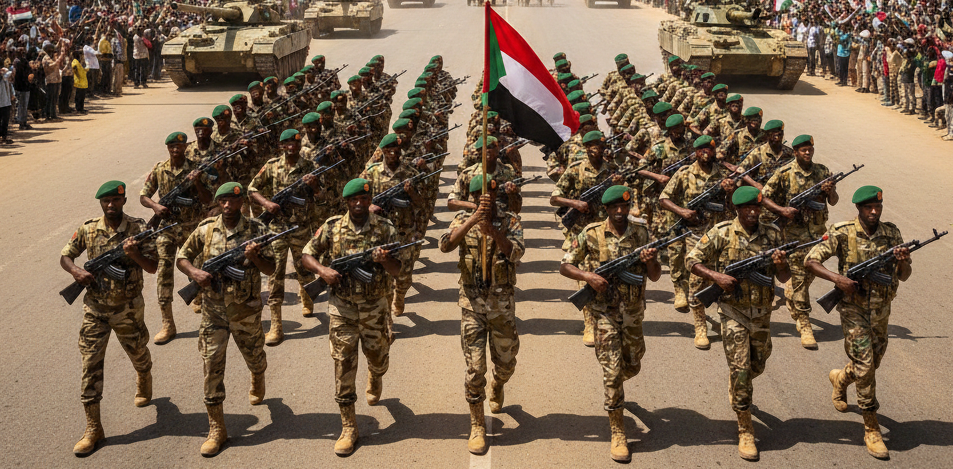
On January 12, 2026, the Sudanese army announced it is renewing efforts and preparing to launch a large-scale military operation to retake the Kordofan and Darfur regions from Rapid Support Forces control. In a statement, the army said “its forces conducted strikes against RSF positions, destroying about 240 combat vehicles and killing hundreds of fighters,” adding that “ground forces succeeded in pushing RSF fighters out of wide areas in Darfur and Kordofan, and operations are ongoing to pursue remaining elements.” The army described this operation as exceeding the Khartoum recapture in terms of “planning that preceded the mission.”
Background:
Kordofan – Sudan’s Economic Heart: Kordofan is a vast region in central Sudan, comprising three states: North Kordofan, South Kordofan, and West Kordofan. This region is extremely vital for several reasons:
- Agricultural: A vast agricultural area producing essential crops
- Oil: Contains Sudan’s oil fields, including the Heglig field (largest oil field)
- Strategic: Connects east to west, an obligatory passage
In December 2025, the Rapid Support Forces seized the Heglig oil field after a drone attack. This was followed by a tripartite agreement (Sudanese army, RSF, South Sudan) to deploy South Sudanese forces to secure the field and neutralize it from combat – a forced concession by both parties to prevent production stoppage. Currently, the Rapid Support Forces are surrounding El-Obeid city, capital of North Kordofan and Sudan’s second-largest city, and have targeted civilians including a kindergarten.
Darfur – Region of Open Wounds: Darfur is a region in western Sudan, approximately the size of France. It witnessed genocide between 2003-2005 that claimed about 300,000 lives and led to the displacement of millions. The Janjaweed forces (which later transformed into the Rapid Support Forces) were primarily responsible for those crimes. Now, Darfur is under almost complete Rapid Support Forces control after the fall of El-Fasher (capital of North Darfur and the army’s last stronghold in Darfur) in October 2025.
Analysis:
Unprecedented Military Ambition: The army described this operation as larger than the Khartoum recapture – and this means a lot. Recapturing Khartoum took months of fierce fighting and hundreds of casualties. An operation including both Kordofan and Darfur will be much larger and more complex, in terms of:
- Geography: Vast areas, varied terrain (desert, mountains, plains)
- Logistics: Very long supply lines from the east
- Enemy: Rapid Support Forces are strongly positioned and know the terrain well
The army says it has “reorganized and redeployed forces in various parts of Kordofan” and “many military formations are fully ready to launch the attack,” indicating that preparations are serious and not mere talk.
Multi-dimensional Strategic Importance:
Economically: Oil is the artery of the Sudanese economy (despite its decline after South Sudan’s independence). Whoever controls the oil fields in Kordofan controls vital financial resources to fund the war. Currently, the fields are neutral due to the tripartite agreement, but whoever controls the surrounding area can determine production and export terms. Also, Kordofan is an agricultural area – controlling it means food.
Geographically: Kordofan is Sudan’s “backbone” – connecting east to west. Control over it means cutting Rapid Support Forces supply lines between Darfur (its main stronghold) and any other areas it seeks to expand toward. In other words: whoever controls Kordofan can “strangle” the other party.
Politically and Morally: Recapturing Kordofan and Darfur will be a huge morale victory for the army and government. Darfur in particular has special symbolism – if the army can “liberate Darfur from the Janjaweed,” it will present itself as a “savior” of Sudanese who suffered from genocide. This will strengthen its position in any future peace negotiations.
Expected Enormous Challenges:
Militarily:
- Rapid Support Forces have extensive guerrilla warfare experience and know the terrain
- Their intensive use of drones may inflict heavy casualties on advancing army forces
- Vast areas make complete control difficult – even if the RSF is expelled from cities, it may remain capable of launching attacks from rural areas
Logistically:
- Supply lines from the east are very long and vulnerable to targeting (as shown by the Sinja attack)
- Transporting ammunition, fuel, and food for a large army across hundreds of kilometers in a war zone is a huge challenge
- Weather (desert heat, sandstorms) will affect operations
Humanitarianly – Expected Catastrophe: Both regions contain millions of civilians, most already displaced in camps. Any large-scale military operation will mean:
- More mass displacement
- More civilian casualties
- Worsening famine (how will aid reach during fighting?)
- Likelihood of new atrocities by both parties
External Support – Proxy War: This battle is not just Sudanese-Sudanese:
For the Army:
- Egypt: Reports of Egyptian weapons flowing for months
- Turkey: Military support, especially drones
- Saudi Arabia: Reports of potential funding for an arms deal between the army and Pakistan – first declared Saudi military support
For the Rapid Support Forces:
- Regional network: Bases in Chad and Libya for transporting supplies
This means the battle in Kordofan and Darfur is also an influence struggle between an axis (Egypt-Turkey-Saudi Arabia), increasing its complexity and difficulty to end.
Possible Scenarios:
Success Scenario (from the army’s perspective):
- The army gradually retakes control of major cities in Kordofan
- Cuts RSF supply lines
- Pushes toward Darfur and retakes some areas
- Weakens the RSF militarily and economically to the point of forcing negotiations from a weak position
Failure Scenario:
- The operation falters against fierce resistance
- Supply lines are continuously targeted
- Heavy losses without strategic gains
- Army exhaustion and continuation of war
Stalemate Scenario:
- The army achieves some gains but cannot achieve complete control
- Both parties each control areas
- Sudan freezes in a state of “de facto partition” – east for the army, west for the RSF
Consequences:
Short-term (coming months):
- Major military escalation
- Thousands of casualties (military and civilian)
- New waves of displacement
- Worsening famine in combat areas
Medium-term:
- If the operation succeeds, it may bring the war closer to a military end
- If it fails, the war may continue for years
- Financial and human exhaustion will be enormous for both parties
Regional Importance:
- The battle will determine the future of regional influence in the Horn of Africa
Conclusion: This is not just a military battle – it is an existential gamble for both parties, with deep economic, political, and regional dimensions. The coming months will be decisive in determining the course of the Sudanese war, and perhaps the fate of Sudan itself as a unified state.