
Strategic Analysis
Introduction
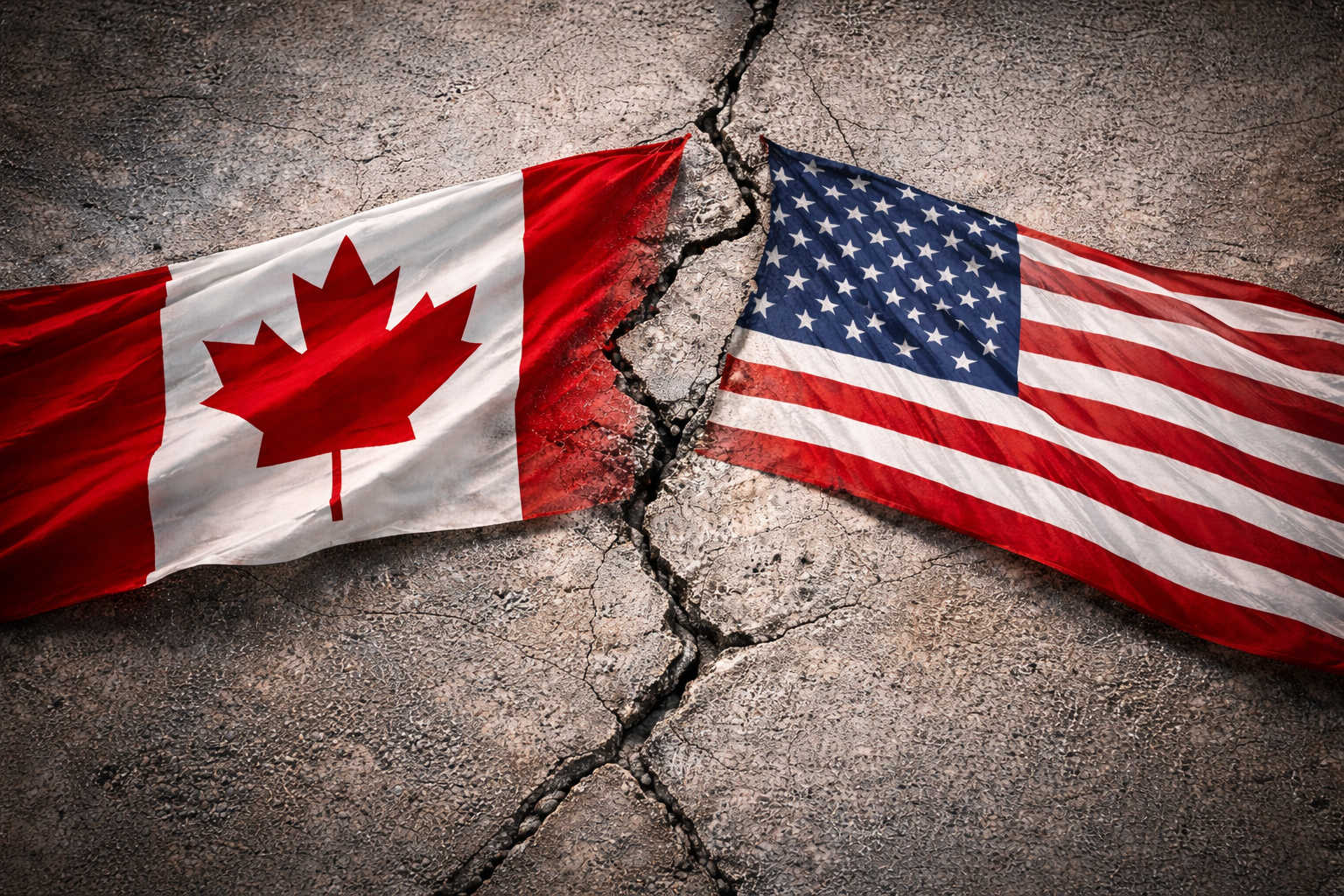
The relationship between Canada and the United States is passing through an unprecedented period of strain not seen since the end of the Cold War — yet accurate diagnosis requires distinguishing between what is tactical and what is structural. Canada stands at what Carney has called a “hinge moment,” facing an American administration that is redrawing the terms of its relationships with traditional allies. The more relevant question is not “Is the partnership over?” but rather “On what terms will it be renegotiated?”
What is most likely unfolding is not a separation but a painful renegotiation of the balance of interests, driven by exceptional circumstances yet constrained by the enormous geographic and economic weight binding the two countries together. Canada is the first test of Trump’s model for managing allies on the basis of immediate self-interest rather than institutional partnership, and the outcome of that test will shape how Washington deals with its other Western allies.
I. The Nature of the Current Tension
The crisis began in early 2025 when Trump imposed sweeping 25% tariffs on most Canadian imports. Ottawa responded with retaliatory tariffs on $155 billion worth of U.S. goods within three weeks. Yet this trade escalation did not produce a rupture — it generated parallel negotiating tracks, revealing that both sides recognize the cost of full decoupling.
The American logic extends beyond economics toward a redefinition of power balances across the Western Hemisphere. What the Eurasia Group describes as the “Donroe Doctrine” reflects Washington’s expectation that neighboring allies will offer concessions rather than negotiate as equals. Even so, Washington treats Canadian defense initiatives as overdue remedial measures rather than negotiating concessions, narrowing Ottawa’s room for maneuver without closing it entirely.
II. Economic Weight Sets Limits for Both Sides
Mutual dependency remains the strongest brake on any serious escalation scenario. Roughly $2.5 billion in goods and services crosses the border daily; Canada supplies 60% of U.S. crude oil imports and 85% of U.S. electricity imports, and is the top export destination for 36 U.S. states. These figures make any genuine rupture nearly equally costly for both parties — which explains why the USMCA framework has remained intact despite sustained pressure.
At the same time, 67% of Canadian exports still flow to the U.S. market even under the current tariff regime, a figure that makes Canadian independence rhetoric more aspirational than achievable in the near term, pushing Ottawa toward gradual diversification rather than abrupt decoupling.
III. Carney’s Strategy: Hedging While Keeping the Door Open
Carney’s approach rests on a dual logic: raising the cost of American pressure while keeping the negotiating channel open. Canada concluded 12 new economic and security agreements across four continents within six months, alongside a stated goal of doubling non-U.S. exports over the next decade. On the defense side, directing 70% of defense contracts to Canadian firms can equally be read as a negotiating lever with Washington rather than purely a move away from it.
The most likely trajectory is Ottawa’s effort to convert friction points — defense spending, border security, fentanyl — into a permanent negotiating framework that produces a comprehensive economic-security agreement, rather than managing recurring crises on an ad hoc basis.
IV. The Limits of Bold Rhetoric
Some analysts compare Canada’s position to Finland’s during the Cold War, facing the Soviet Union — with the caveat that Ottawa’s options may be even narrower, given that Canada lacks the collective memory of a nation that has lived through occupation or forced dependency. This means that Canadian public opinion, despite the current wave of nationalism, may not sustain the economic cost of prolonged confrontation with Washington.
Carney appears to understand this. His meeting with Trump at the White House was described by both sides as “very positive” and free of tension, signaling that the dialogue channel remains open and that the rhetorical escalation serves the negotiating posture more than it reflects a final strategic direction.
Conclusion: What Is Actually Most Likely?
The most probable scenario over the medium term is a pragmatic understanding that resets the relationship on more reciprocal terms, with Canada retaining a wider margin of autonomy than it held before 2025. The partnership will not return to what it was, but it will not collapse. What is taking shape is a new model: a conditional alliance in which Canada negotiates its terms rather than accepting them by default.