
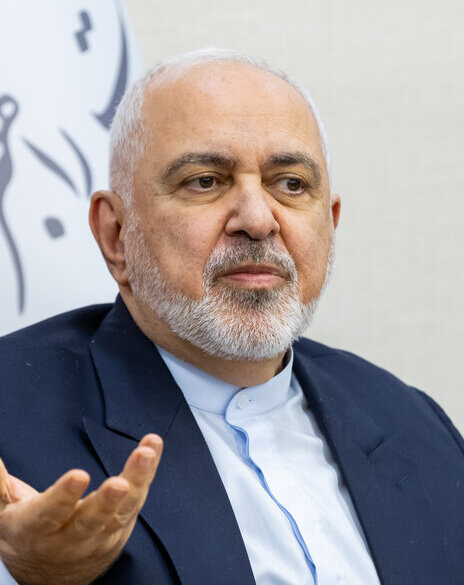
Within a few days of the war’s outbreak, former Iranian Foreign Minister Javad Zarif sent an internal message to a closed circle of Iranian analysts—it was never intended for the public. Shortly thereafter, he published an open article in Foreign Affairs addressed directly to U.S. President Donald Trump and the Washington public. Reading the two texts together reveals not only a difference in language but a profound gap in political thinking between a domestic mobilizational discourse and an external negotiating discourse—one man addressing two audiences simultaneously.
At Home: The Language of Deterrence and the Unseen
The leaked message began with a bitter admission: Zarif wrote that he had submitted a proposal to prevent the war, involving symbolic steps that would give Trump a sense of victory while preserving Iran’s dignity. He noted that figures like Ahmet Davutoğlu, Richard Falk, and Celso Amorim agreed to support it—yet he received no response from officials in Tehran. He wrote with visible resentment: “Since the day the war began, I have not received a single call from my former colleagues at the Foreign Ministry.”
But Zarif did not stop at complaining. He moved directly to what he deemed necessary for this stage, and his first recommendation was explicit: “We must focus on hitting American and Israeli targets. Inflicting damage on U.S. naval vessels, vital interests, and Israeli leaders is essential.” He went further, suggesting the destruction of the bridge connecting Saudi Arabia and Bahrain as a tool of “true deterrence,” as well as striking the UAE, adding a striking phrase that summarizes his regional vision: “The UAE means Israel.”
However, the message contained even more surprising passages, revealing another dimension of the thinking of one of Iran’s most prominent diplomats. Zarif called for prayers to fulfill the prediction of a “Chinese fortune teller” regarding Trump’s defeat and spoke of how divine intervention could have a “quantitative effect” on the course of the war. He recommended the repeated recitation of the Adhan (call to prayer) to “nullify the satanic games” of Trump and Netanyahu, based on a claim that they had “begun sacrificing 200 young girls in the style of Epstein.” These specific passages reveal how much war can blur the levels of political thought, even for a man known for his rationalist discourse with the West.
Yet, in the same message, Zarif was not merely a mobilizer. He dedicated significant points to the dimension of negotiation: “We must not reject mediation proposals,” and “An honorable exit must be provided for Trump.” In the message’s boldest moment, he wrote that “the only thing that can calm Trump is an official declaration ending 47 years of hostility between Iran and America and its allies”—acknowledging at the same time that any settlement limited only to the nuclear file “is no longer possible after the war.” He concluded his message with an internal warning that seemed more human than his previous points: “Any steps that anger any segment of the people must be avoided. We must win the hearts of the people.”
Abroad: The Language of the Deal and History
When Zarif moved to his Foreign Affairs article, he seemed like a different person. There was no trace of striking the UAE, no mention of destroying the Bahrain bridge, and no talk of direct military deterrence. Even the spiritual and symbolic elements vanished entirely from the discourse.
What replaced them was a carefully crafted narrative based on three consecutive claims: that Iran is “winning the war” on the ground despite ongoing raids; that it has proven its resilience and maintained its leadership continuity even in the face of high-level assassinations; and that the war was not inevitable—that a path remains open toward a comprehensive settlement. Finally, the most tactically oriented claim: that a new deal with Iran could become a “historic achievement” for Trump.
This last phrase reveals that Zarif was negotiating, not just analyzing. He was intentionally speaking the language of the U.S. President—the language of deals, legacy, and personal victory—because he believed this was the only way to reach him. His true audience was not the magazine’s readers, but Trump himself and those around him.
Hamad bin Jassim’s Comment: When Qatari Diplomacy Speaks
What gave Zarif’s Foreign Affairs article weight beyond its academic context was the comment by former Qatari Prime Minister and Foreign Minister Hamad bin Jassim bin Jaber Al Thani—a man who rarely comments unless he calculates the weight of every word.
Bin Jassim wrote directly to Zarif, stating that he agreed with the proposed solutions and saw them as a “real way out of the current crisis.” However, he added with a frankness rare in diplomatic discourse: “The problem is not the idea, but the courage to announce and adopt it.” He then sent a clear implicit message to Tehran, saying that the countries of the region “did not participate in deciding this war and will not do so,” and that “the method of response, however powerful it may seem, has left deep side effects that will not be easily erased.” He concluded with a sentence that summarized the entire message: “Calling for a solution is not defeat; it is courage. Continuing on this path is a drain on everyone without exception.”
Bin Jassim’s comment was not read in regional capitals as mere intellectual solidarity with an Iranian diplomat. It was read as a dual message: to Tehran, that the price of continuation is high; and to Washington, that a mediator is ready. Qatar, as in previous crises, positioned itself in this spot with extreme precision.
Two Discourses for One Man
When placing the two texts side-by-side, it becomes clear that Zarif was not changing his position as much as he was changing his tools. At home, he spoke the language of military deterrence, regional structure, and religious symbolism, surrounded by analysts who understood the context and shared his horizon. Abroad, he spoke the language of deals and historic achievements, addressing a man who sees the world through the lens of profit and loss.
The unifying hypothesis between the two texts is that Zarif never for a moment abandoned his core conviction: Trump is a man who can be talked to, provided the words are presented to him in the right way. At home, he described it as “an offer he cannot refuse.” Abroad, he translated it into a “historic achievement.” The idea is the same, the audiences are different, and the style shifts—this is exactly what diplomats mean when they talk about the art of negotiation.