
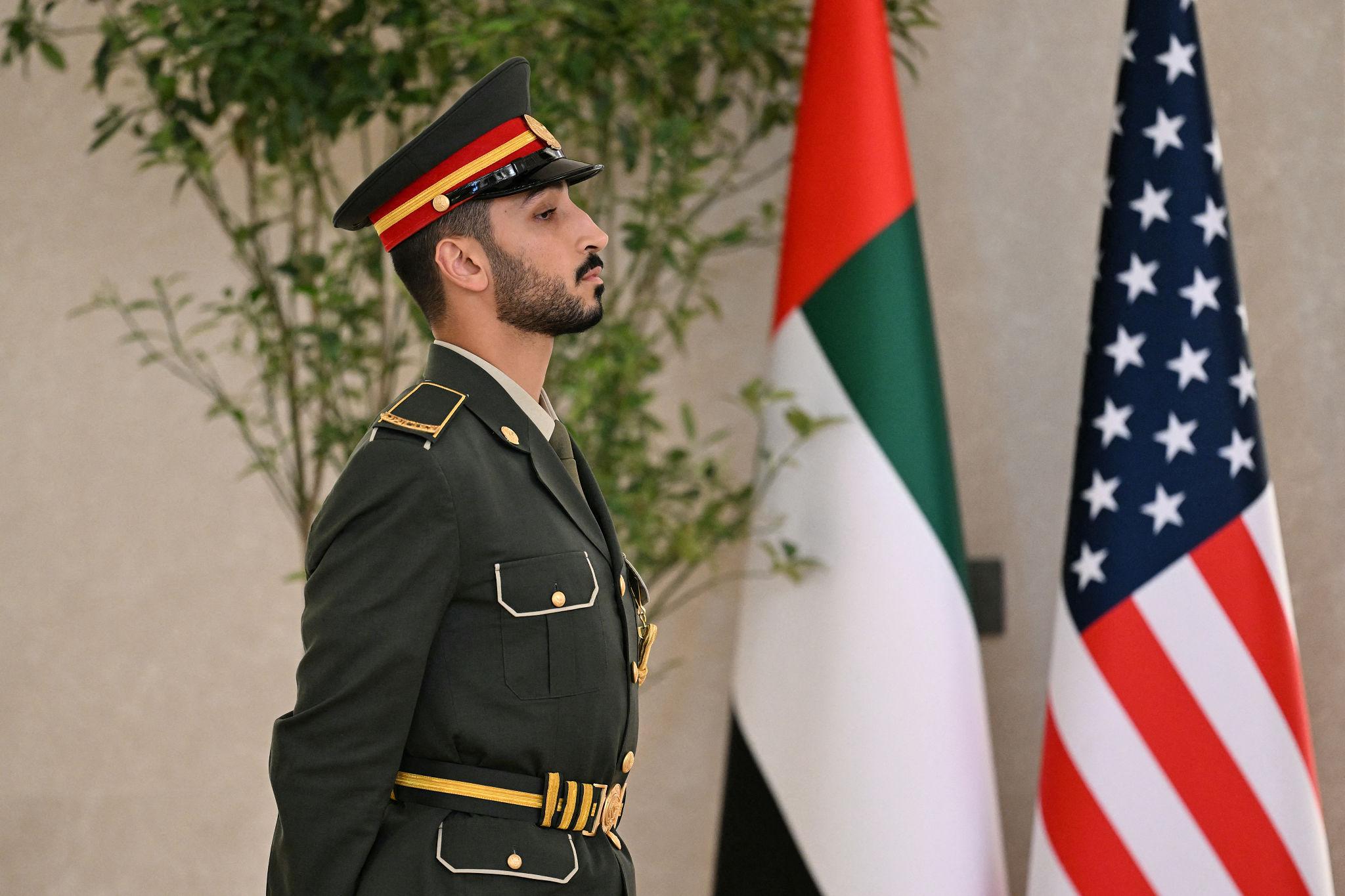
The News
Dr. Abdul Khaleq Abdullah, a political science professor with close ties to Abu Dhabi’s decision-making circles, raised fundamental questions about the future of U.S. military bases on Emirati soil, telling Reuters that these bases have become “a burden, not an asset,” and calling for serious consideration of their closure. In response, prominent commentator Nadim Koteich rejected this view, arguing that the U.S.-UAE relationship has moved well beyond its military dimension and is now deeply rooted in technological and industrial partnership.
Context and Background
These statements come in the wake of the sharp escalation that has gripped the region over recent weeks:
- The UAE announced the interception of 17 ballistic missiles and 35 Iranian drones in April 2026, bolstering confidence in its autonomous defense capabilities.
- Iran claimed to have struck a U.S. command facility near Al-Minhad, alleging casualties among American forces.
- The Dubai and Abu Dhabi stock exchanges suffered losses exceeding $120 billion, over 18,400 flights were cancelled, and Dubai’s real estate index fell at least 16% since the war began.
- The conversion of some Gulf bases into military launchpads has effectively made host countries direct parties to the conflict equation.
Significance for the United States
This debate touches three vital American interests simultaneously:
First: Regional security dominance — bases such as Al-Dhafra Air Base and the operational infrastructure spread across the Gulf form the backbone of America’s military footprint in the region.
Second: Control over energy arteries — any retreat in American presence weakens Washington’s ability to guarantee freedom of navigation through the Strait of Hormuz, through which roughly 20% of the world’s oil passes.
Third: Containing Chinese and Russian expansion — any potential security vacuum would invite Beijing and Moscow to deepen their political and security presence in the region, which Washington classifies as a long-term strategic threat.
Regional Implications
The Gulf landscape is drifting gradually toward security pluralism:
- Saudi Arabia signed a “Joint Strategic Defense Agreement” with Pakistan in September 2025, activated by the arrival of Pakistani air forces on Saudi soil in April 2026.
- Qatar is expanding partnerships with Turkey, the UK, and France — particularly after an Israeli strike hit a civilian building in Doha in September 2025.
- Bahrain signed a defense cooperation agreement with France covering training, strategic intelligence sharing, and defense industry collaboration.
- Kuwait launched a Defense Strategy 2025–2030 and signed a deal with Raytheon to close air defense gaps exposed by recent attacks.
Yet this diversification remains complementary rather than a genuine alternative to the American security umbrella, given the ongoing Iranian threat and the incomplete state of independent operational capabilities.
Assessment
Dr. Abdullah’s statements function more as a trial balloon in the media space than an official Emirati policy position. They reflect a genuine anxiety about Abu Dhabi being dragged into wars it did not choose — but do not necessarily point to an imminent policy decision. Abu Dhabi is negotiating in silence: it wants advanced weapons deals — including what it has previously been denied, such as F-35 fighters — without paying the price of being drawn into a direct confrontation with Tehran.
Three Scenarios:
- Quiet Bargaining (most likely): Abu Dhabi uses this discourse as leverage to extract defense and arms concessions from Washington, without taking any actual escalatory step regarding the bases.
- Gradual Reconfiguration (possible): The UAE shifts toward a “repositioning” model similar to trends in other Gulf states — scaling back and restructuring the direct presence into less provocative forms of technical and security partnership.
- Strategic Reversal (least likely): Accumulated economic and security pressures drive a fundamental review, opening the door to Chinese or Russian influence in a vacuum no regional power has yet filled.
What to Watch Today
- Will official Emirati statements emerge confirming or distancing from Abdullah’s positions?
- The trajectory of U.S.-UAE talks on the stalled F-35 deal.
- Reactions from Qatar and Bahrain — will they join this debate or differentiate themselves from it?
- Beijing’s posture toward Emirati efforts to diversify their defense partners.