
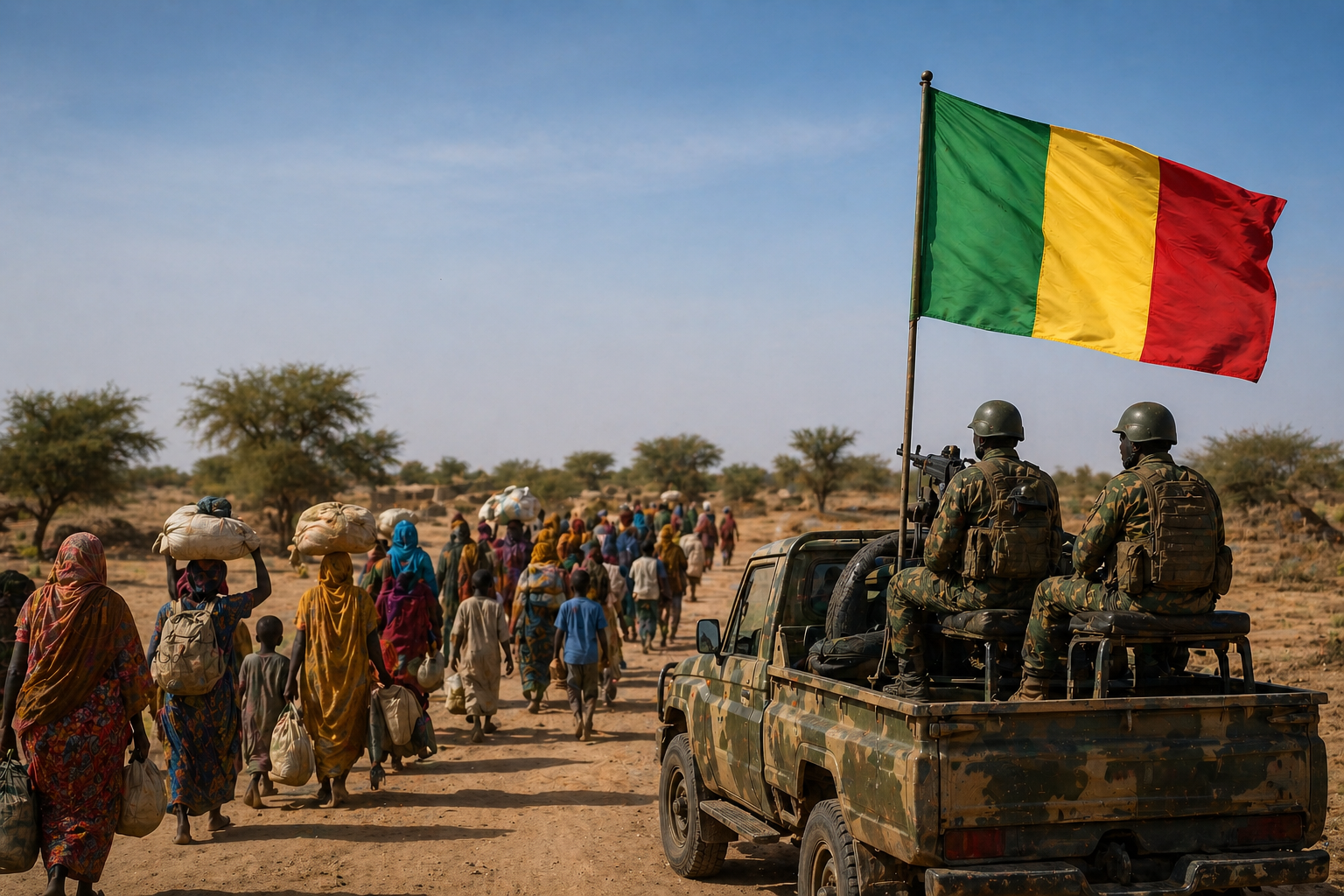
In the early hours of Saturday, April 25, Jama’at Nusrat al-Islam wal-Muslimin (JNIM), al-Qaeda’s Sahel affiliate, carried out a series of simultaneous attacks across Mali in coordination with the Tuareg-led Azawad Liberation Front (ALF). The operation targeted five fronts concurrently:
• Bamako and Kati: Attacks struck the capital’s outskirts and the main military base at Kati, west of Bamako.
• Kidal and Gao: Heavy fighting erupted in northern Mali, resulting in ALF seizure of Kidal.
• Sévaré and Mopti: Clashes in central Mali with reported civilian and military casualties.
• Deadliest strike: A suicide attack on the residence of Defense Minister Sadou Camara in Kati killed him from his wounds. Camara was the second-most powerful figure in the ruling military council.
The Malian Armed Forces later announced they had restored control over most locations, though clashes in Kati reportedly continued into a second day.
Kidal: A Symbolic Collapse
The ALF announced full control of Kidal — the historic heartland of Tuareg separatist movements — which Malian forces, backed by Russian Africa Corps fighters, had retaken in 2023.
Under what rebels described as an “agreement,” Malian troops and Russian Africa Corps elements withdrew from the city. The ALF also claimed control of several positions in the Gao region to the north.
Immediate Reactions
Malian Government: Initially declined to identify the attackers. The Foreign Minister then issued implicit accusations against unnamed neighboring states for sponsoring “terrorist groups” — widely read as directed at Algeria.
Russia: Condemned the attacks and declared solidarity with Bamako. However, the withdrawal of its forces from Kidal raises questions about the scope of its continued commitment.
United Nations: Secretary-General expressed “grave concern” and called for coordinated international support to address rising violent extremism in the Sahel.
United States & United Kingdom: Both embassies urged citizens to shelter in place. The UK issued a “do not travel” advisory for Mali.
Mauritania: The Foreign Ministry issued a formal statement of concern, reflecting fears of refugee influx and militant infiltration across its extensive shared border.
Background
Mali has faced successive waves of armed insurgency since 2012, driven by al-Qaeda- and ISIS-linked groups alongside Tuareg separatist movements in the north.
Following military coups in 2020 and 2021, the country has been ruled by a junta led by President Assimi Goïta. The government expelled French forces, wound down the UN mission (MINUSMA), and pivoted toward Russia. In 2024, it annulled the Algiers Peace Accord — the last structured political framework for dialogue with armed groups.
From mid-2024, JNIM shifted strategy toward an economic siege: targeting fuel supply routes from Senegal, Mauritania, Guinea, and Côte d’Ivoire. By September 2025, the blockade had cut fuel imports by 80%, paralyzing economic activity in the south. A ceasefire brokered in late March 2026 collapsed amid mutual recriminations over its terms.
On April 10, 2026, Mali announced its withdrawal of recognition from the Polisario Front and full backing for Moroccan sovereignty over Western Sahara, triggering a sharp diplomatic rupture with Algeria — just two weeks before these attacks.
What to Watch
• Negotiations between Bamako and ALF over the status of Kidal and terms of any new ceasefire.
• Whether Russian Africa Corps redeploys or further reduces its footprint in Mali.
• Algeria’s formal response to Malian accusations in light of the ongoing diplomatic breakdown.
• Humanitarian conditions in Kidal and Gao following the change of control.
• Any movement toward renewed international engagement following UN calls for support.