
The News
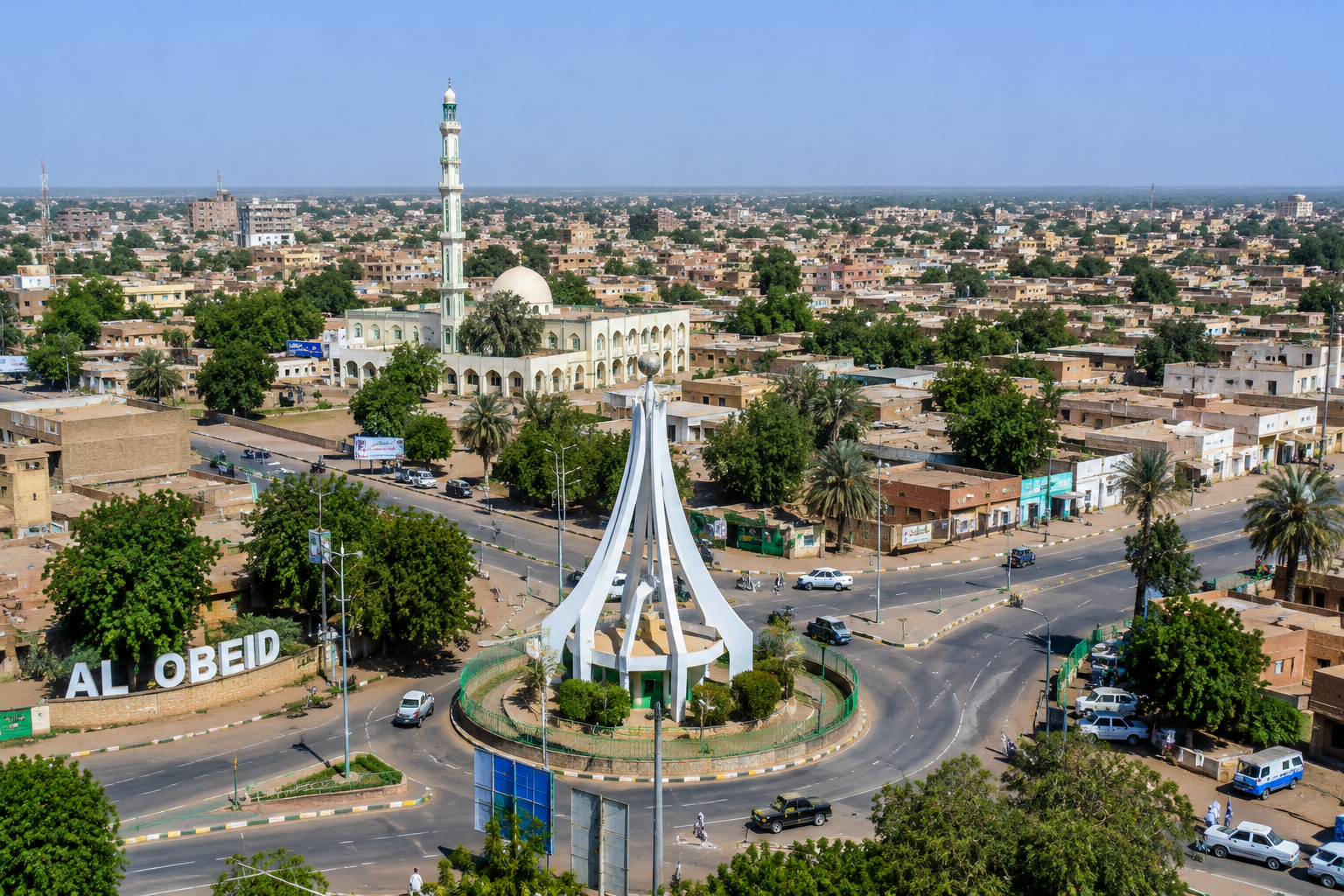
El Obeid, capital of North Kordofan State, is experiencing the most intense wave of aerial bombardment since the war began. At least 23 civilians were killed and 19 wounded in a series of drone strikes attributed to the Rapid Support Forces (RSF), running from the evening of Wednesday, June 10 through the morning of Thursday, June 11, targeting residential neighborhoods, a funeral gathering, and a food-supply truck. The bombardment continued for a fifth consecutive day through Sunday, June 14, concentrated on fuel stations, with roughly five stations destroyed. The RSF has not formally claimed the attacks, while some sources attribute the latest wave to a joint operation between the RSF and the Sudan People’s Liberation Movement–North (the Abdelaziz al-Hilu faction). The UN estimates that drone attacks across Sudan killed at least 880 civilians during the first four months of the year.
The shift to drone warfare is not a tactical choice but a tacit admission of ground-level incapacity. After consolidating its control over Darfur following the fall of El Fasher in October 2025, the RSF pushed east toward Kordofan—only to run into a string of battlefield defeats: the army recaptured Bara in March 2026, secured El Obeid’s perimeter, and broke the siege of Dilling after nearly two years. When a party can no longer achieve a ground decision, it shifts from a strategy of control to a strategy of denial: if I cannot take the city, I will not let you make use of it. The drone is the ideal weapon for this logic—cheap, long-range, turning El Obeid from a launchpad for the army’s westward advance into a security and humanitarian liability.
Significance for the United States
What is unfolding in El Obeid is a miniature test of the limits of American influence. Washington nominally leads the Quad (the United States, Egypt, Saudi Arabia, and the UAE), but faces a structural dilemma: two of its Gulf partners sit on opposite sides of this war—Riyadh behind the army, Abu Dhabi behind the RSF. Washington has called for an immediate, three-month humanitarian truce without preconditions, and Trump’s Africa adviser Massad Boulos is working on a truce beginning with demilitarization in El Fasher and parts of Kordofan. But absent a unified Emirati–Saudi position, any agreement remains a dead letter.
El Obeid also reveals a military model that worries American planners: low-cost drone warfare capable of paralyzing an entire state—a pattern replicable from Yemen to the Sahel. Moreover, every additional month of stalemate is a month gained for the expansion of armed groups in the vacuum of state authority, tying the Sudan file directly to Red Sea security, counterterrorism in the Horn of Africa, and the balance of geopolitical competition with Russia and China.
Implications
First — the war has entered a phase of armed stalemate, not decision. The central fact is the near-complete geographic partition: the RSF controls Darfur, while the army reclaims the center and east and advances in Blue Nile (in mid-June it announced the destruction of 141 combat vehicles across the three fighting axes). Kordofan is the line of contact between the two blocs, and El Obeid is the hinge. Neither can break the other, so the war becomes one of attrition along an internal border between two zones of influence.
Second — Kordofan is the theater of 2026 as Darfur was the theater of 2025. With the Darfur file closed in the RSF’s favor, the war’s center of gravity has moved east. Kordofan—with its oil wealth and its position as a gateway—is the leading candidate for the year’s most intense fighting.
Third — the RSF’s alliance with the SPLM-N (al-Hilu) is redrawing the map. The merger of South Kordofan’s ideologically rooted insurgency with the RSF grants the latter geographic depth in the south and opens a third front that disperses the army between Blue Nile, Kordofan, and Darfur.
Fourth — the decisive factor is external, not internal. The war is no longer decided in Kordofan but in Riyadh, Abu Dhabi, and Washington. The Saudi–Emirati rift has turned the conflict into a proxy contest, and the army’s recent edge in Kordofan is tied to Riyadh’s mobilization of regional states to shift the balance. As long as that rivalry persists, the drones will keep flying over El Obeid.
Scenarios
Scenario One (most likely) — entrenchment of the stalemate with drone attrition: The RSF fails to storm El Obeid by ground and continues bombarding it to disrupt its logistical role and deny the army its use as a base for advancing toward Darfur. Kordofan becomes a practically frozen but bloody line of contact, with slow humanitarian erosion. This is the trajectory all current indicators point toward.
Scenario Two — an army attempt to break the stalemate westward: The army leverages the momentum of Bara and Blue Nile and pushes into West Kordofan to retake Babanusa and the oil fields, setting the stage to threaten the RSF’s Darfur heartland. This requires aerial-defense superiority to neutralize the drones first—a condition not yet met.
Scenario Three (most dangerous) — internationalization of the drone war: The RSF widens the scope of strikes to include the cities of the center and north (Umm Siyala as a launch platform toward Khartoum and the north), turning the war into low-cost, high-impact aerial attrition that reaches the national infrastructure.
Assessment: Scenario One is the new default. The paradox is that the key to El Obeid lies not in Kordofan, but in Washington’s ability to tame the rivalry between Abu Dhabi and Riyadh.
What to Watch
- El Obeid’s fuel stations: Continued targeting threatens an acute energy crisis in North Kordofan, affecting wide areas that depend on the city for services.
- The Quad track: Any sign of Saudi–Emirati convergence or divergence will be the true indicator of the truce’s future—more than any battlefield development.
- The Blue Nile front: The army’s advance against the RSF–SPLM-N alliance could redistribute pressure on Kordofan.
- Umm Siyala: Its persistence as a drone launch platform keeps alive the threat of expanded strikes toward the center and north.
- The SPLM-N (al-Hilu) posture: The consolidation or retreat of its alliance with the RSF will determine whether the South Kordofan front opens fully.