
The Story
Egypt’s Foreign Ministry announced Monday that it is closely monitoring the hijacking of oil tanker M/T Eureka, which had twelve crew members on board — eight Egyptian and four Indian nationals. In an official statement, the ministry confirmed that Foreign Minister Badr Abdelatty directed Egypt’s embassy in Mogadishu to continuously monitor the sailors’ conditions and provide all necessary support, adding that Cairo is coordinating “at the highest levels” with Somali authorities to ensure the crew’s safety and secure their release as swiftly as possible. The ministry did not disclose the identity of the group responsible for the hijacking or the circumstances surrounding it.
The Voyage and the Hijacking
The tanker — a small vessel built in 2006 flying a Togolese flag, operated by Royal Shipping Lines Inc. linked to the Hamriyah Free Zone in Sharjah — departed the port of Fujairah on March 24, 2026. It remained in a waiting area near the Omani port of Sohar until April 21, before continuing along the coasts of Oman and eastern Yemen. On April 30, it reached the waters off Shabwa Governorate near the Bir Ali area, where its route appeared entirely routine and normal.
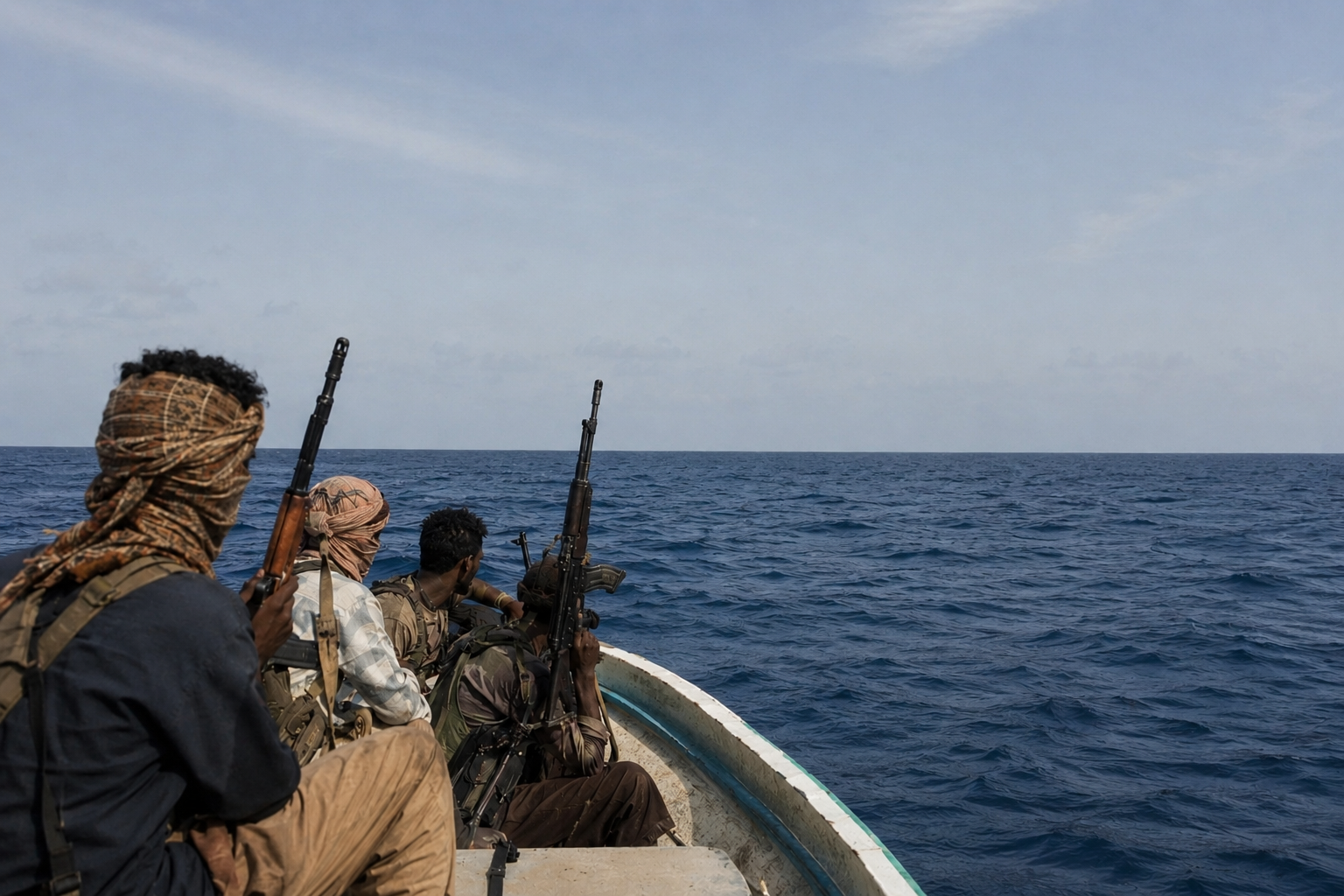
In the early hours of May 2, armed men believed to be pirates from Somalia’s Puntland region stormed the tanker and seized control, before redirecting it across the Gulf of Aden toward Somali waters. According to Puntland security officials, the hijackers departed from a remote coastal area near Qandala, and carefully designed the attack route to move the vessel beyond the reach of any Yemeni or international intervention, drawing it into a “gray zone” where smuggling networks and cross-border militias intersect. Yemen’s Coast Guard declared its inability to pursue the vessel due to the limited range of its patrol boats. Reports indicate the tanker is currently anchored near Bosaso, Eyl, or Qandala.
Current Situation and Ransom
Families of the sailors report that their loved ones are suffering from severe shortages of food and water, and that communication has become nearly nonexistent. The hijackers are demanding a comprehensive ransom covering the vessel, its oil cargo estimated at tens of millions of dollars, and the crew. Negotiations between the hijackers and the operating company have edged toward total collapse following the company’s alleged refusal to pay. The brother of one of the sailors said the communication blackout is deepening fears that the crisis could drag into a prolonged standoff reminiscent of the worst scenarios of the classic piracy era.
Background
This tanker is neither the first nor likely the last in this wave. Since late 2023, the waters of the Gulf of Aden and the Horn of Africa have witnessed a notable resurgence in Somali piracy activity, following years of relative calm that followed the golden era of piracy between 2008 and 2018. Puntland in particular has always been the geographic incubator for Somalia’s most prominent piracy networks, as its vast coastline and small isolated ports provide a safe haven far from an already fragile Somali government oversight. The Houthis, since the regional war erupted in early 2026, have become a new factor in the maritime security equation, possessing the capacity to influence shipping movement through the Gulf of Aden and the Bab al-Mandab Strait.
Why This Story Matters
The significance of this story extends well beyond an isolated maritime incident, operating on three interconnected levels. On the humanitarian level, twelve sailors are being held in harsh conditions, families are waiting in deep anxiety, and negotiations are stalled with an operating company that appears unwilling to pay. On the regional security level, the incident exposes a critical strategic vulnerability — the Gulf of Aden, which connects the Indian Ocean to the Red Sea and through which roughly 12% of global maritime trade passes, has become an open arena for the converging interests of the Houthis, pirates, and Iranian networks. On the broader strategic level, the incident represents a genuine test of Egypt’s ability to protect its citizens in distant hotspots, and of security coordination between Cairo and Mogadishu on a matter of acute sensitivity.
Broader Context — The Return of Somali Piracy
The M/T Eureka incident represents the fourth hijacking in those waters within just a few weeks, suggesting that what we are witnessing is not a series of isolated incidents but rather an organized and escalating pattern. Security analysts argue the attack bears the hallmarks of what they call a “dual corridor strategy” — a coordination between Somali pirates and Iranian-linked armed networks, in which the Houthis provide geopolitical cover and advanced surveillance and tracking equipment, while the pirates handle the operational role at sea.
This pragmatic alliance — if confirmed — represents a dangerous qualitative shift. Somali piracy is no longer merely organized crime driven by purely financial motives; it now carries a geopolitical dimension that renders traditional countermeasures — naval patrols and ransom negotiations — insufficient to address its true roots. International observers are drawing a direct link between this escalation and the widening security vacuum in the Gulf of Aden amid the region’s burning war, warning that if this trajectory continues, it could produce a “dual-front crisis” combining the closure of the Strait of Hormuz to the north with threats to Bab al-Mandab to the south — a devastating blow to the arteries of global trade.