
Context and Timing
The leaders of the Gulf Cooperation Council held an extraordinary consultative summit in Jeddah on Tuesday to discuss regional developments and efforts to de-escalate tensions between the United States and Iran, against the backdrop of the ongoing war’s security and economic repercussions. The summit comes amid accelerating international moves aimed at ending the war and supporting the indirect negotiation track between Washington and Tehran through Pakistani mediation.
The United States and Israel launched their war against Iran on February 28, with Tehran responding by striking what it described as American positions and interests across the region, predominantly in Gulf states. On April 8, a temporary ceasefire was announced under Pakistani mediation, with the hope of reaching a final agreement. On April 11, Pakistan hosted a round of talks between the two sides that yielded no deal, after which President Trump announced an extension of the ceasefire pending Iran’s submission of a formal proposal, with no timeline specified.
Participants
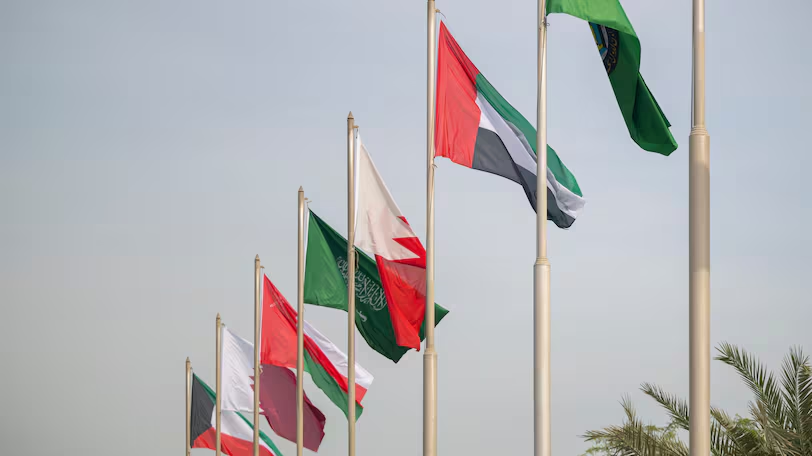
The summit was chaired by Saudi Crown Prince and Prime Minister Mohammed bin Salman, with the participation of leaders and delegation heads from all six GCC member states: Saudi Arabia, Kuwait, the UAE, Qatar, Bahrain, and Oman.
Agenda Files
File One — Regional Security and Iranian Aggression
Leaders discussed the latest regional developments and ways to address the repeated attacks attributed to Iran and its proxies, which have targeted critical infrastructure, civilian facilities, and oil installations across GCC states. The summit examined ways to strengthen the collective security framework to protect member states’ economic assets from future attacks, with a focus on activating protection protocols for vital facilities that have recently come under hostile fire.
File Two — The Strait of Hormuz and Maritime Navigation
This is unquestionably the summit’s most critical file. The closure of Hormuz means the disruption of roughly 20% of global oil supplies, and the Gulf states themselves are among the primary victims — their oil exports are effectively blockaded and revenues under pressure, even as the price per barrel has exceeded $110. The paradox is stark: the Gulf is suffering from an Iranian-imposed closure despite having no part in the war.
Qatar’s Permanent Representative to the United Nations had told the Security Council that the growing threats to international maritime corridors, including the Strait of Hormuz, now represent a danger that transcends conventional challenges and threatens international peace, security, and the global economy.
Against this backdrop, Axios reported that Iran submitted a proposal to lift the mutual blockade on Hormuz in exchange for a long-term extension of the ceasefire or a permanent end to the war. Whether the White House is prepared to consider it remains unclear. This proposal will loom large in the summit room, as Gulf leaders have a direct stake in pressing Washington to either engage with it or formally reject it — either way, the economic uncertainty demands resolution.
File Three — Pakistani Mediation and Diplomacy
The summit reviewed the latest developments in Pakistan’s mediation efforts and exchanged perspectives on the six states’ future foreign policy orientations toward Iran. This comes as Tehran holds firm to its conditions and Washington refuses to negotiate under the pressure of what it calls the “maritime blockade” and nuclear threats — leaving political progress hostage to the mediators’ ability to narrow the gap between the two sides.
File Four — Gulf Unity
The summit reaffirmed the commitment to the strength and cohesion of the GCC, the unity of its ranks, and the importance of setting aside any intra-Gulf differences during this phase, standing as one in the face of any threat directed at any member state.
File Five — Non-Use of Gulf Territory
GCC states firmly reiterated their rejection of any use of their territory as a platform for hostile operations against Iran, affirming their commitment to regional security and shared interests. This constitutes a clear red line that distinguishes the Gulf’s position in this moment.
File Six — Energy Markets and Supply Chains
The summit also addressed the crisis’s impact on global energy markets and supply chains, with oil prices having surpassed $110 per barrel amid mounting uncertainty over the conflict’s trajectory.
Historical Background
At the 1998 GCC summit, member states agreed to hold a semi-annual consultative meeting between regular summits. The first such consultative summit was held in Jeddah in May 1999, with the aim of coordinating positions and enhancing cooperation on regional and international issues.
Assessment
This summit convenes at an exceptionally sensitive moment, defined by three simultaneous pressures: the security pressure stemming from attacks on Gulf infrastructure, the economic pressure tied to the Hormuz closure and elevated oil prices, and the diplomatic pressure of managing relations with both Washington and Tehran concurrently.
The Gulf appears to be positioning itself as an active mediator rather than a drawn-in party, while holding to one clear red line: refusing to allow its territory to become an operational theater. Ultimately, every file on the agenda — Pakistani mediation, collective security, the future of relations with Tehran — converges on a single question: when and how does the Strait of Hormuz reopen?