
The News
Riyadh is exploring a regional security framework modeled on the 1975 Helsinki Accords, built around three pillars: non-aggression, economic cooperation and stable energy flows, and verification and implementation mechanisms. The initiative emerged in the wake of the US-Iran war that erupted on February 28, 2026, and the missile and drone strikes that struck Gulf infrastructure throughout the conflict, before a ceasefire entered into force on April 8, 2026. An Arab diplomat told the Financial Times that such an agreement would be welcomed by “most Arab and Muslim states, as well as Iran,” while European officials and EU institutions have expressed support for the Saudi-led initiative.
Background
Iran’s closure of the Strait of Hormuz in response to US-Israeli strikes triggered what Gulf states described as the worst global energy crisis in decades. Following Pakistani and Qatari mediation, a ceasefire took hold on April 8 — though it remains fragile, with disputes over the conditions for fully reopening the strait still unresolved. Against this backdrop, Gulf states found themselves confronting a new strategic reality: US military bases did not deliver the protection expected when genuinely tested, and military deterrence alone proved insufficient. That calculus has driven Riyadh toward building long-term security arrangements that do not depend entirely on American guarantees.
The Causes
First: Deep Gulf concern that Iran may emerge from the war militarily weakened but ideologically hardened, and more reliant on indirect escalation through its regional proxy networks.
Second: The direct economic lesson of the Hormuz crisis — any prolonged disruption to the strait threatens Vision 2030 revenues and investor confidence, and exposes oil infrastructure and ports to permanent risk that alternative pipelines cannot resolve.
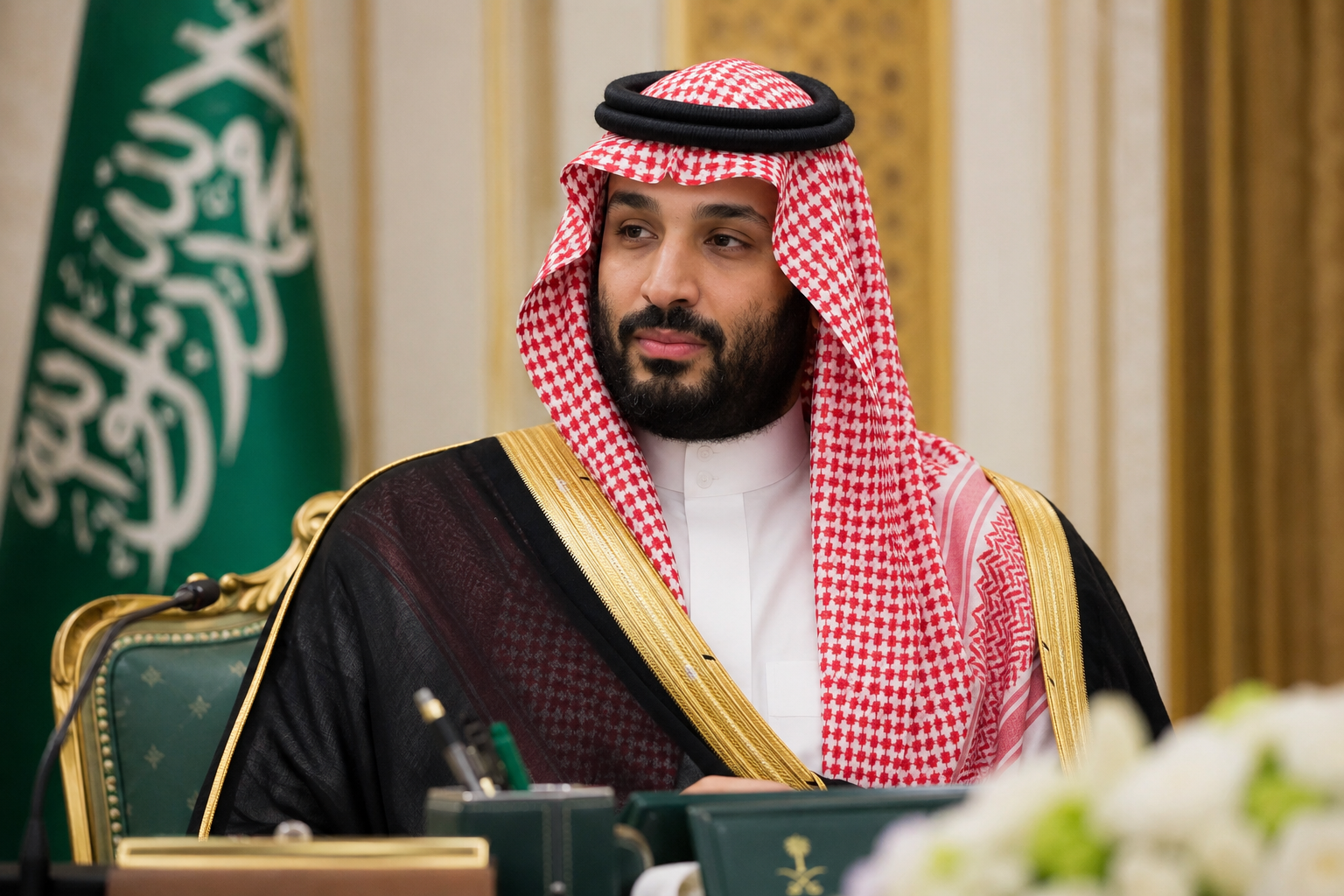
Third: MBS drew two painful lessons from the Yemen war: that impulsive decisions carry a heavy price, and that there is no such thing as a quick war. This explains his reluctance to participate in — or even endorse — the war against Iran, and his return to a posture of strategic patience and long-term positioning.
Fourth: Growing uncertainty about the sustainability of US military engagement at its current level, pushing Riyadh to build regional arrangements that are not wholly contingent on American security guarantees.
Implications
- If successful, the framework could establish a new model for managing Gulf-Iran tensions based on structured de-escalation rather than military deterrence — a structural shift in the logic of regional security.
- A durable agreement could reshape regional alignments and ease the sectarian Sunni-Shia divide that has drained the region for decades.
- The fundamental obstacle remains: regional conflicts are not driven solely by inter-governmental disputes — they are fed by proxy networks, armed factions, and ideological rivalries that traditional state-to-state agreements cannot easily contain.
- Israel will likely oppose any framework that offers Iran security guarantees, viewing it as a rollback of the maximum-pressure strategy.
- Iran may exploit the framework to recover and reposition its capabilities without making substantive concessions on its nuclear program or proxy infrastructure.
Why This Matters to the United States
The proposal presents Washington with two competing faces:
The upside: Any arrangement that reduces the likelihood of a new military confrontation in the Gulf eases pressure on the US military presence and shields global energy markets from the kind of disruption that drives inflation and pushes interest rates higher.
The downside: The framework could gradually reduce Gulf states’ dependence on the American security umbrella in favor of more autonomous regional arrangements — quietly eroding Washington’s political and military leverage. Analysts have flagged an even more sensitive scenario: Gulf states and Europe effectively bypassing Washington, refusing to allow their airspace and waters to be used for any military or intelligence activity against Iran. This dynamic matters all the more because Washington is currently pursuing its own bilateral deal with Tehran — Trump announced it was “largely negotiated” on May 24 — making the Gulf-European framework a potential competitor to US diplomacy rather than a complement to it.
Assessment
The Saudi proposal is more than a diplomatic initiative — it is an implicit declaration of strategic reorientation. Riyadh is acknowledging that military deterrence did not hold under the pressure of 2026, and that regional stability is an existential precondition for its modernization project, not merely a policy goal. The invocation of Helsinki is precise in its logic: Saudi Arabia is not aiming to resolve its dispute with Iran permanently, but to establish rules that prevent rivalry from tipping into open war.
Yet the fundamental gap between the original Helsinki process and this proposal remains sharp. Helsinki worked — to the extent it worked — because two symmetric blocs sat across from each other with mutually assured nuclear destruction holding the floor. The Gulf has none of that architecture: Iran is simultaneously a state and an ideological system with a proxy empire, and any agreement’s durability depends on volatile Iranian political will and competing domestic pressures.
Success requires three conditions, none of which is guaranteed simultaneously: at minimum tacit American support, Iranian buy-in in substance not merely in signature, and a verification mechanism with real enforcement teeth. In the absence of any one of these, the proposal remains an important diplomatic statement — but not yet functional security architecture.