
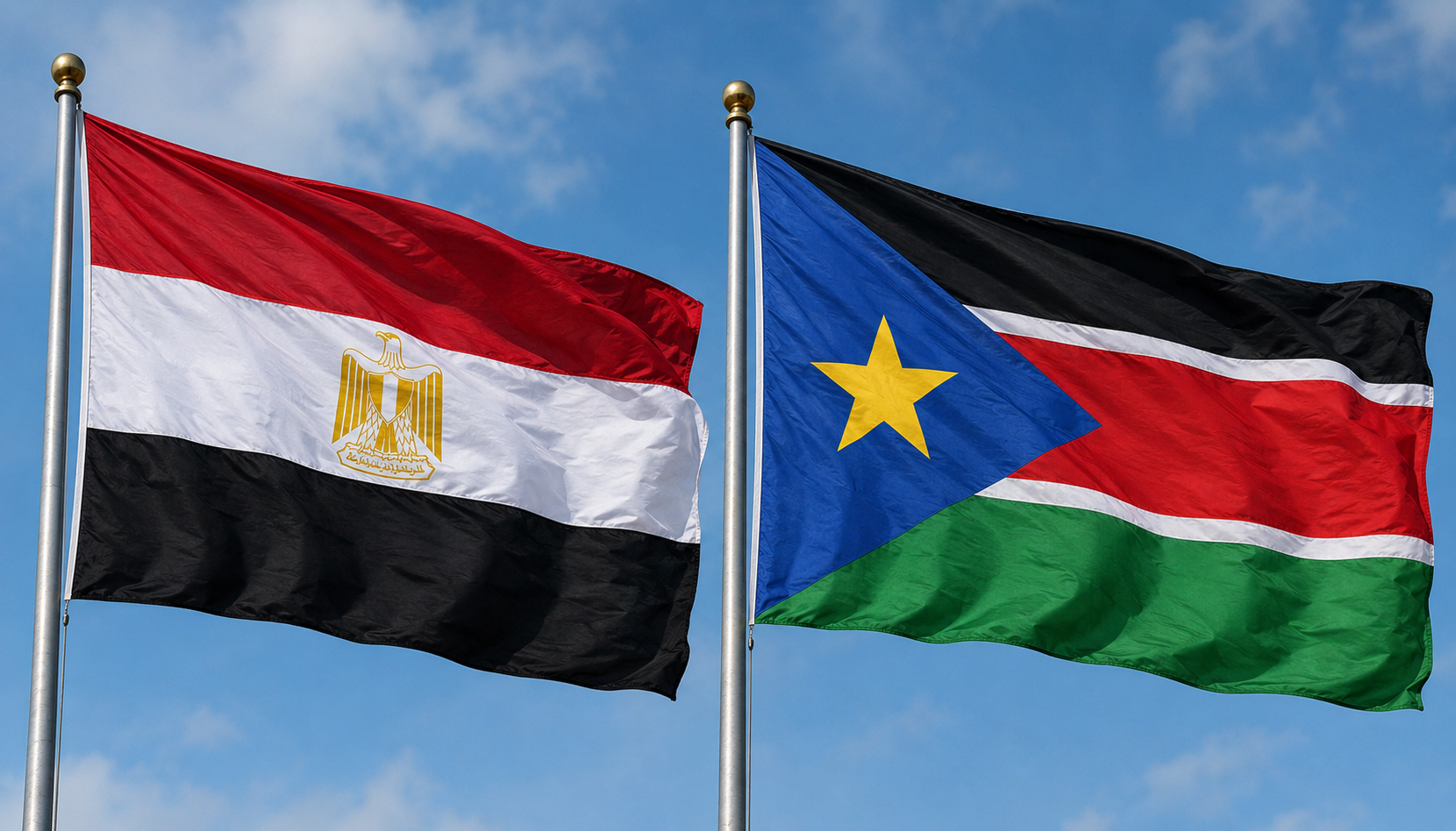
The News
Regional media outlets — without official confirmation from Cairo or Juba to date — are circulating reports that South Sudan has requested the closure of an Egyptian military base in the Jot area of Upper Nile State, demanding a full end to all Egyptian military activities in the region. The base sits in a strategically sensitive location near the tri-border junction of Sudan, Ethiopia, and South Sudan, and in close proximity to Ethiopia’s Benishangul-Gumuz region, where the Grand Ethiopian Renaissance Dam is located.
Background
For years, Egypt has deepened its military and security cooperation with South Sudan through training and support agreements, using the Jot area as a logistical and security foothold near the Ethiopian border. The region holds considerable strategic value for Cairo given its proximity to the Nile’s headwaters and to the GERD — the chronic flashpoint in Egypt-Ethiopia relations. Against this backdrop, South Sudan took a major diplomatic step in July 2024 by ratifying the Nile Basin Cooperative Framework Agreement (the Entebbe Agreement), which entered into force in October of that year — a move that effectively distanced Juba from Egypt’s traditional position and aligned it more closely with the upstream states led by Ethiopia.
The Causes
Several overlapping factors appear to be driving this step:
First: The geographic sensitivity of the site amid escalating Sudan-Ethiopia tensions, including Khartoum’s accusations that Addis Ababa was behind drone strikes on Sudanese territory — which led Sudan to summon the Ethiopian chargé d’affaires — prompting Juba to avoid being seen as a platform for any party to the dispute.
Second: South Sudan’s desire to reposition itself regionally toward Ethiopia, particularly as the GERD reaches full operational capacity and Ethiopia’s economic weight in East Africa continues to grow.
Third: Acute domestic economic pressures — Sudan had previously halted the transit of South Sudanese oil through the Heglig facilities following RSF drone attacks — making Juba increasingly wary of entanglement in neighboring conflicts.
Implications
- A retreat of Egypt’s military footprint near the Ethiopian border would weaken Cairo’s capacity for indirect security influence on the GERD file.
- The potential security vacuum could allow Ethiopia and other regional actors to expand their presence in the sensitive Upper Nile region.
- The intensifying internal conflict in South Sudan — with over 280,000 people displaced in Jonglei state alone since the start of the year — means that any shift in external power balances hits a state that is already deeply fragile.
- Over the longer term, the Egypt-South Sudan relationship may transition from active security partnership to less direct forms of cooperation, further narrowing Cairo’s room for maneuver in the Nile Basin.
Why This Matters to the United States
American interest here goes well beyond the Egyptian base itself — what matters is what this episode reveals about the reshaping of the regional order across a zone that has become strategically vital to Washington on three levels: Red Sea security and global energy corridors; containing Russian and Chinese expansion in East Africa; and managing the Nile water file before it escalates into open conflict. Washington also views South Sudan as a pivotal state in the Horn of Africa’s energy, transit, and influence equations — meaning any military or political repositioning in Juba reads, from an American perspective, as a signal of broader realignment among regional partners at a particularly sensitive moment.
Assessment
If confirmed officially, this closure would not represent merely a tactical military setback for Egypt — it would mark a deeper structural shift in the regional balance of power across the Nile Basin. South Sudan is moving with increasing speed toward an upstream axis led by Ethiopia, driven by pragmatic economic and security calculations rather than any hostility toward Cairo. Egypt, for its part, finds itself in a growing defensive posture: the GERD is operational, the Entebbe Agreement has entered into force, Juba is drifting away, and the war in Sudan is constraining its options at every turn.
The trajectory points toward a new Nile Basin equation that marginalizes Egypt’s traditional role — unless Cairo moves proactively to offer upstream states compelling diplomatic and economic alternatives. That is precisely the kind of opening Washington sees as an opportunity for influence through mediation and support, particularly as the United States recalibrates its engagement across the Horn of Africa.